TLDR: Campaign tracking is the practice of tagging your marketing links (usually with UTM parameters) and monitoring the resulting traffic, leads, and revenue so you know which campaigns, channels, and content are actually working. Set it up in five steps: define your goals and KPIs, tag every campaign link consistently, pick a tracking method, centralize the data in a reporting tool, then review and optimize.
Done right, it turns "we think the campaign worked" into "here's exactly what drove results."
What is campaign tracking?
Campaign tracking is the practice of measuring how your marketing campaigns perform by tagging their links, usually with UTM parameters, and monitoring the resulting traffic, conversions, and revenue in an analytics or reporting tool. It tells you which channel, which campaign, and which piece of content is driving results, and which is quietly wasting budget.
The key word is campaign. Campaign tracking works at the campaign level, so instead of only knowing that "social media sent 4,000 visits this month," you know that "the March retargeting campaign on Facebook sent 1,200 visits, 90 leads, and $6,000 in revenue." That specificity is what lets you double down on what works and cut what doesn't.
It is a subset of broader marketing tracking (which measures everything you do), focused specifically on the performance of defined campaigns.
Why campaign tracking matters
Most marketers overestimate how well they understand their results. Without tracking, budget decisions come down to gut feel, and the campaigns that feel successful are not always the ones actually generating pipeline.
Campaign tracking fixes that in three ways:
- It attributes results to the right source. You see which campaign, channel, and creative earned each conversion, so credit (and budget) goes to what works.
- It protects your budget. When you can see that one channel converts at 2% and another at 8%, reallocation is obvious. Teams that track and optimize consistently routinely report large gains. In DashThis case studies, agencies have tied tracking-driven optimization to conversion-rate lifts of 58%, 154% more conversions, and 167% more leads.
- It makes reporting fast and credible. Tagged, centralized data means client and stakeholder reports are a click away instead of a Monday-morning spreadsheet marathon.
Want to skip the spreadsheet exports? Try DashThis free for 14 days and pull every campaign's tracking data into one automated dashboard.
Campaign tracking methods compared
There is no single "right" way to track a campaign. Most teams use a combination. Here is how the main methods compare.
| Method |
What it does |
Best for |
Watch out for |
| UTM parameters |
Tags added to URLs (utm_source, utm_medium, etc.) that pass campaign info to your analytics tool |
Almost every campaign: the default for email, social, and paid links |
Inconsistent naming breaks reports: needs a naming convention |
| Tracking pixels |
A snippet that fires when someone views a page or converts, used by ad platforms and retargeting |
Paid ads, retargeting, conversion tracking |
Privacy rules and cookie consent can limit coverage |
| Platform-native tracking |
Built-in reporting inside Google Ads, Meta, LinkedIn, etc. |
Deep, channel-specific metrics |
Data is siloed per platform: hard to compare across channels |
| Analytics platforms (GA4) |
Aggregates UTM and on-site behavior into one property |
Site-wide behavior and conversion paths |
Setup and attribution modeling have a learning curve |
| Reporting tool (e.g. DashThis) |
Pulls tracking data from all of the above into one live dashboard |
Cross-channel reporting and client dashboards |
Complements, not replaces, your tracking setup |
Understanding UTM parameters (the building blocks)
UTM parameters are the most common tracking method, so they are worth understanding in detail. A UTM (Urchin Tracking Module) parameter is a tag you append to a URL. When someone clicks, the tags travel with them and tell your analytics tool exactly where they came from.
A tagged link looks like this: https://dashthis.com/?utm_source=newsletter&utm_medium=email&utm_campaign=spring_launch
There are five UTM parameters:
| Parameter |
What it captures |
Example |
Required? |
| utm_source |
Where the traffic comes from |
newsletter, facebook, google |
Yes |
| utm_medium |
The channel type |
email, cpc, social, referral |
Yes |
| utm_campaign |
The specific campaign name |
spring_launch, black_friday_2026 |
Yes |
| utm_content |
Which creative or link variant |
hero_cta, sidebar_banner |
Optional (great for A/B tests) |
| utm_term |
The paid keyword |
campaign+tracking |
Optional (mostly paid search) |
The single most important rule: be consistent. "Facebook," "facebook," and "FB" are three different sources to your analytics tool, and mixing them splits one campaign's data into three. Agree on a naming convention (lowercase, underscores, no spaces) and stick to it.
Building links by hand is where typos creep in. Use the free DashThis UTM Campaign Builder to generate consistent, error-free tracking URLs.
How to track a marketing campaign in 5 steps
Follow these five steps to set up campaign tracking that actually holds up in reporting.
-
Step 1: Define your goal and KPIs.
Decide what the campaign is meant to achieve (leads, sales, sign-ups, awareness) and the one or two KPIs that prove it. A lead-gen campaign tracks conversions and cost per lead; an awareness campaign tracks reach and engagement. Pick the metrics before you launch, not after.
-
Step 2: Tag every campaign link consistently.
Add UTM parameters to every link that points to your site, across email, social, paid, and partner placements, using your naming convention. Consistency here is what makes steps 4 and 5 possible.
-
Step 3: Choose your tracking method(s).
For most campaigns that means UTMs plus GA4, with native platform tracking and pixels for paid media. Match the method to the channel.
-
Step 4: Centralize the data in a dashboard.
Pull every channel's tracking data into one place so you can compare campaigns side by side. This is where a reporting tool earns its keep: instead of exporting from five platforms, you see all campaigns in one live view.
-
Step 5: Review, compare, and optimize.
On a set cadence (weekly or per campaign phase), review performance against your KPIs, compare channels, and shift budget toward what converts. Tracking is only valuable if it changes what you do next.
Steps 4 and 5 are the ones teams skip because they are tedious by hand. DashThis automates them by connecting to your marketing tools and updating your campaign dashboard automatically.
Which metrics should you track?
The right metrics depend on your goal, but most campaigns come back to a core set: click-through rate (CTR), cost per click (CPC), conversion rate (CVR), cost per acquisition (CPA), and return on ad spend (ROAS) for paid campaigns. Track the two or three that map to your KPI rather than everything at once.
This article keeps the metrics view deliberately short, because we have a dedicated guide that goes deep. For the full breakdown of what to track and how to interpret it, see campaign metrics to track.
Automating campaign tracking with DashThis
Once your campaigns are tagged and your tracking method is in place, the remaining work is pulling everything together and keeping it current. That is what a reporting tool does.
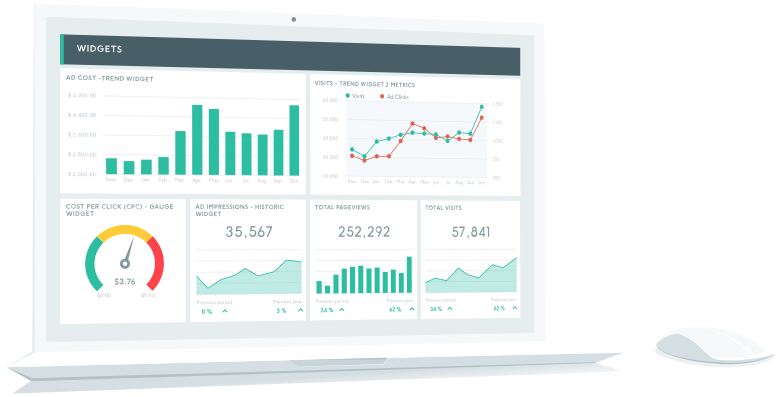
DashThis connects to your favorite marketing integrations (Google Analytics, Google Ads, Meta, LinkedIn, email tools, and more) and pulls their tracking data into one automated dashboard. Your UTM-tagged campaigns show up organized by source, medium, and campaign, so you can compare performance across every channel in one view without exporting a single spreadsheet. Reports update automatically, which is why agencies use it to keep dozens of client campaigns current at once.
Here’s how it works:
- Select a free ads report template
- Connect your favorite advertising platform(s) with DashThis (e.g., Google Ads, Google Analytics)
- Pick your PPC metrics in Preset Widget
DashThis will automatically gather your entire data into your report. Drag and drop them to form a cohesive look (e.g., Facebook Ads in one section, LinkedIn Ads in another).

You can also add notes and comments within the report (note: this tip is ideal for folks frustrated with the back-and-forth emails with clients).
Say you want to convince a client to replicate your top-performing ad messaging into your organic social media posts. Or create a new email campaign to nurture the incoming free trial users.
Click Static Widget > Add Comment.
Here’s how it might look when you explain the ROI of email marketing and recommend a new email sequence to convert trial users to paid customers.

Once you’re done, schedule an automated email dispatch:
- Hover to the Sharing Options icon on the top right
- Click Share by Email
- Set the dashboard period and frequency
- Click Schedule
Now your report is sent to all stakeholders according to your preferred period and frequency, automatically.

Alternatively, send over a URL link.
Both sharing options allow everyone to view the reports in real-time.
Now that it’s possible to automate reports in the blink of an eye, you can finally ditch those manual tasks, gain back hours of your time, and spend more of your days on billable work.

Yes, your report could look this great!
Frequently asked questions
What is a campaign tracker?
A campaign tracker is a tool or system that captures and organizes the performance data of your marketing campaigns, typically by reading UTM parameters and pulling metrics like clicks, conversions, and revenue into one place. It can be a spreadsheet, an analytics platform like GA4, or an automated reporting tool like DashThis.
What are the different types of campaign tracking methods?
The main methods are UTM parameters (tags on your URLs), tracking pixels (snippets that fire on views or conversions), platform-native tracking (built into Google Ads, Meta, and similar), and analytics platforms like GA4 that aggregate the data. Most teams combine several and centralize the results in a reporting tool.
Why is campaign tracking important?
Because without it, you are guessing. Campaign tracking attributes results to the specific campaign, channel, and creative that earned them, so you can move budget toward what works and stop funding what doesn't. It also makes reporting to clients and stakeholders fast and credible.
What is a campaign tracking code?
A campaign tracking code is a set of UTM parameters (like utm_source, utm_medium, and utm_campaign) added to a URL so your analytics tool can attribute a visit to a specific campaign, channel, and creative. You can build one manually or with a free UTM builder.
Automate Your Campaign Tracking with DashThis Today!
From messaging to untapped audience, campaign tracking helps you spot all kinds of hidden opportunities you can think of.
For best results, track your campaigns with an automated PPC reporting tool like DashThis.
It auto-grabs your entire ads data across different channels into one beautiful report. Either create a standalone ads report or an all-in-one marketing dashboard in one place (note: DashThis also integrates with other marketing channels like Ahrefs, Klaviyo, CallRail, and more).
Unpublish
DashThis is the easiest reporting tool. Start your free 14-day trial to automate campaign tracking, gain back hours of your time, and spend more of your days on billable work today.
 The Team at DashThis
DashThis is the power behind thousands of reporting dashboards created by and delivered for agencies and digital marketers every month.