Content Marketing Reporting: Best Practices, Metrics & Templates
You need a better handle on your content marketing reporting when the blog posts you publish have generated zero sales.
The days of tracking only publishing frequency, web traffic, and likes are long gone. With more companies aligning their different departments to drive revenue, content has become an indispensable tool in the sales cycle.
But what metrics should you focus on to convince clients that the content you created impacts the bottom line? More importantly, how do you fit them together to tell a story and hold their attention?
In this guide, we’ll recommend our favorite content metrics and how you can start measuring them in a beautiful automated report in the blink of an eye.
- Understanding Content Marketing Reporting
- Top Content Marketing Metrics to Track
- Content Marketing Reporting Templates
- Elevate Your Content Marketing Reporting with DashThis
Understanding Content Marketing Reporting
Content marketing reporting measures the business impact of your content marketing campaigns.
The days of brainstorming topics on a whim and manually tracking vanity metrics on Excel spreadsheets are fizzling.
Today, modern marketers auto-measure content performance based on revenue-driven outcomes: quality leads, won opportunities, revenue growth… you know, all the stuff that marketing, sales, product teams, and every C-suite executive LOVE.
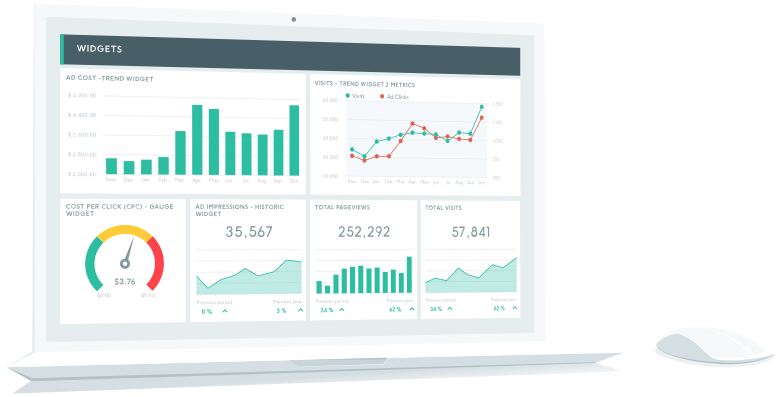
Take this pre-built content marketing report created on DashThis. It automatically tracks how content marketing fuels the business’s bottom line, informing stakeholders how every page and keyword impact the lead generation funnel.

Note again how the content marketing metrics are automatically transformed from raw numbers into scroll-stopping graphs and charts. Stakeholders can gauge the content performance at a 15-second glance.
DashThis gathers all your marketing data automatically. Track individual or multiple marketing channels (e.g., PPC ads, social media platforms) all at once into one beautiful dashboard. Start your free 15-day trial to gain back hours of your time today.
Why it is crucial to report on your content marketing
Effective content greases the wheels to drive sales.
It achieves your long-term business goals, whether it's attracting big-time influencers for a collaboration, closing a $100,000 deal from running webinars, or getting on podcasts to tap into a new audience.
But it's unlikely you'll invest in all these marketing channels. Imagine the amount of resources needed when you're already operating on a tight budget…
A better way? Make attribution a core part of your B2B content marketing efforts to identify your top-performing channels and double down on them.
That way, you can:
- Track the performance of every piece of content accurately: Content marketing analytics inform your next move. Before you decide to create a bunch of founder-led content, share listicles with sales and CS to speed up the sales process, or expand the content team, etc., analyze your content marketing reporting tool first. This will help you identify rooms for improvement and boost your content marketing ROI.
- Optimize every content for success: Content goes stale after a period. Attribution helps you decide which content is worth bumping up on the SERPs and maximize your content resources.
- Understand reader engagement confidently: KPIs and engagement metrics like average time on page and organic traffic help you deduce if searchers find your content valuable. Instead of creating topics based on guesswork, look into your content marketing reports to pinpoint patterns in best-performing posts.
Content marketing reporting helps you get more out of your efforts.
You'll have an easier time identifying the channels, content, and conversations that drive a return of investment.
Top Content Marketing Metrics to Track
Metrics tell you how close you are to hitting your marketing goals. Here are the metrics we recommend to monitor a content marketing strategy from start (brand awareness) to finish (return on investment).
Note: some of these metrics are not directly related to sales, but they do help you see if your content is heading in the right direction (e.g., a high number of quality backlinks, which increase a website’s ranking and traffic, may raise the likelihood of visitors converting to leads and customers).
Organic traffic

Organic traffic refers to the number of visitors arriving at your website from search engines (organic search).
Pageviews

Pageviews is the total number of web pages viewed.
Number (and quality!) of backlinks

Backlinks refer to external sites linking to your website.
Focus on in-depth quality content (e.g., industry research, subject matter expertise from the in-house team) to attract do follow backlinks from reputable sites.
Average time on page

Average time on page refers to the average time users spent on a specific page.
Bounce rate

Bounce rate is the percentage of visitors that landed and left a website without browsing.
This is the metric to look at when analyzing the user experience (note: high bounce rate on a short-form landing page is very normal!).
Number of leads

Number of leads refers to the leads generated from content creation (e.g., target audience signs up for a free trial after reading a blog post).
Conversion rate

Conversion rate refers to the percentage of website visitors completing a desired goal (e.g., searcher clicking a call-to-action button to subscribe to an email newsletter).
It’s often measured alongside an ad campaign's click-through rate (CTR).
Content Marketing Reporting Best Practices
Tracking the right metrics is only half the battle. How you collect, present, and act on that data is what separates a report that gathers dust from one that actually moves the needle.
Here are the content marketing reporting best practices to build into your process.
Report on a consistent cadence
Ad hoc reporting is the enemy of good decision-making. Set a fixed schedule: weekly for fast-moving campaigns, monthly for ongoing content programs, and quarterly for strategic reviews. Consistency lets you spot trends over time rather than reacting to one-off spikes or dips that may mean nothing on their own.
Tie every metric back to a business goal
Every number in your content marketing report should answer one question: does this move us closer to our goal? Pageviews are meaningless if the goal is lead generation. Leads are secondary if the goal is brand awareness. Before you build a report, define the goal first, then choose the metrics that measure it.
Don't report on everything — report on what matters
A 40-slide deck stuffed with every available metric doesn't show expertise; it shows a lack of editorial judgment. Pick 5–8 KPIs that align with your client's or stakeholder's goals and cut everything else. Focused reports build more trust than exhaustive ones.
Segment your data
Aggregate numbers hide the story. Break organic traffic down by landing page to see which content drives the most visitors. Split conversion rate by channel to see whether blog readers or social media followers convert better. Segmentation turns a flat snapshot into an actionable insight.
Add context to every data point
A 12% drop in organic traffic looks alarming in isolation. In context, say, Google rolled out a core algorithm update that week — it's expected and manageable. Always include brief notes explaining what happened, why it happened, and what you're doing about it. This is the difference between a report and an analysis.
Automate the data collection, not the thinking
The most time-consuming part of content marketing reporting is pulling data from multiple platforms into one place. Automate that part with a tool like DashThis, which connects to 40+ marketing integrations and populates your dashboard automatically. Use the time you save to do the thinking, which is where the real value lies.
Review and update your reporting framework regularly
What you measured in Q1 may not be what matters in Q3. As your content strategy evolves: new channels, new campaigns, new goals and your reporting framework should evolve with it. Schedule a quarterly review of your KPIs to make sure you're still measuring what matters.
Content Marketing Reporting Templates
Our reporting templates convey data-driven content performance at a glance. If your marketing agency needs to distill complex results into digestible chunks for easily bored (erm, busy! that's right, we mean busy!) clients, these templates will help.
Content marketing report template
Driving conversions from high-intent keywords is the gold standard in content.
This comprehensive content marketing report helps you analyze website traffic and keyword rankings in the SERPs across different search engine.
Grab it to uncover your most profitable SEO keywords.

Grab this content marketing dashboard with your own data!
Multi-channel performance report template
Most of your target audience hangs out on specific channels—and it’s every marketer’s job to find them.
With this digital marketing reporting dashboard, you can quickly compare the different types of content promotion across multiple channels before adjusting the next quarter’s content marketing budget.
Use it to pinpoint your top-performing channels.

Grab this multi-channel performance dashboard with your own data!
Elevate Your Content Marketing Reporting with DashThis
A marketer’s time is best spent strategizing next quarter’s campaign.
If you’ve been running yourself ragged from performing repetitive tasks—you know what we’re talking about, monitoring metrics and emailing the marketing team and clients manually—then it’s time to invest in automated content marketing reporting tools like DashThis.
Here’s how it works:
- Select a pre-built template
- Connect your favorite marketing channels (note: there are 40+ integrations available, including Google Analytics, Ahrefs, and LinkedIn Ads)
- Pick your metrics in Preset Widgets
DashThis will pull the selected marketing data into the dashboard automatically. Once they appear on the right side of the editor, drag and drop them to form a cohesive look.

You can also create an interactive experience.
Include notes and comments within the report instead of sharing your analysis in a separate email. On DashThis, hover to the metric you want to expand on and click Add Note > Save.

Your note will be visible to the client in view mode after you send them a shareable URL link to their report. This lets them view the dashboard in real time.
Set up an automatic email dispatch to share your reporting on a pre-defined date.
Content marketing reporting helps you identify your best channels today. Track your performance daily to optimize for social shares and sales.
DashThis gathers data across multiple marketing channels into one beautiful dashboard. Sign up for your free 15-day trial to automate your content marketing reporting in the blink of an eye today.

Start reporting on your content marketing today
Read More

Don’t miss out!
Follow us on social media to stay tuned!


Automate your reports!
Bring all your marketing data into one automated report.
Try dashthis for free